
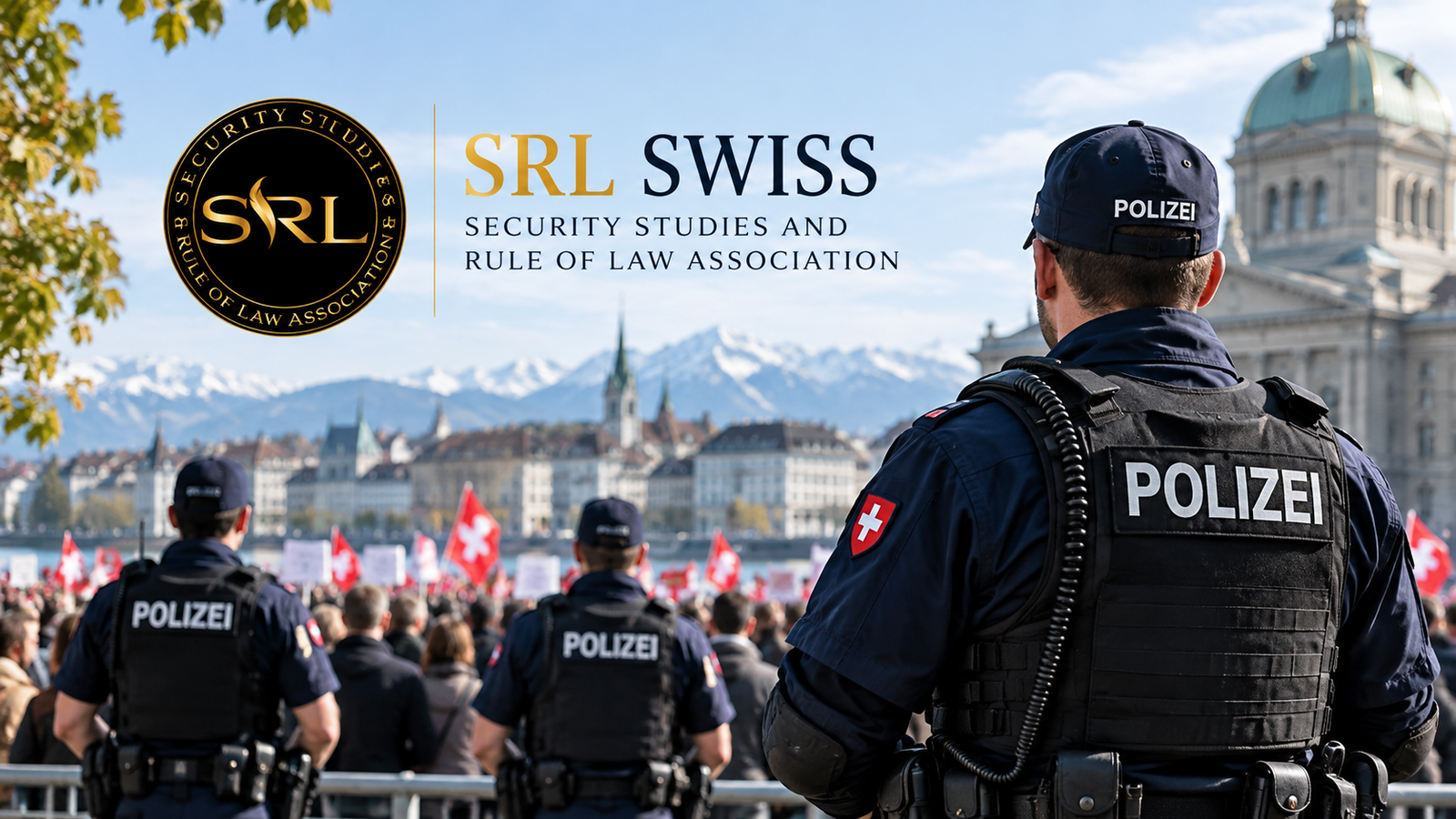
Negotiation in Public Order Policing
A Comparative Analysis of Dialogue-Based Approaches
Democratic Policing and Negotiation | Part 1 of 5
SRL Research Team | 14 October 2026
Peaceful public assemblies are essential expressions of democratic participation and freedom of expression. The way law enforcement responds to demonstrations is therefore more than a question of maintaining public order. It also reflects the democratic character of the state and its commitment to fundamental rights.
Negotiation-based policing offers an approach centred on communication, dialogue and the prevention of unnecessary confrontation. Rather than treating public protest as a threat in itself, this model recognises peaceful assembly as a legitimate part of democratic life.
In the first article of its five-part series, Democratic Policing and Negotiation, SRL Swiss examines international approaches to dialogue-based policing, their institutional foundations and their implications for human rights, police ethics and democratic accountability.
From Confrontation to Communication
Traditional approaches to public-order policing have frequently relied on crowd control, restrictions and the use of force. While police have legitimate responsibilities for maintaining public safety, interventions that unnecessarily restrict peaceful assemblies can undermine public trust and intensify tensions.
Negotiation-based policing seeks to address these risks through direct communication between police officers, assembly organisers and participants. Specialist liaison or dialogue officers can help identify concerns, clarify operational decisions and prevent misunderstandings from developing into confrontation.
However, dialogue must never become a precondition for exercising the right to peaceful assembly.
The United Nations Human Rights Committee, in General Comment No. 37, emphasises the importance of facilitating peaceful assemblies and ensuring that restrictions comply with legality, necessity and proportionality. Participants must not face adverse consequences merely because they decline to engage in dialogue with authorities.
Negotiation should therefore facilitate the exercise of fundamental rights rather than become an instrument for limiting legitimate dissent.
European Experiences: Different Models, Shared Principles
European countries have developed different institutional approaches to dialogue-based policing. Although these models vary in their organisation and implementation, they offer important lessons concerning public trust, communication and the protection of peaceful assemblies.
Sweden: Dialogue Policing
Sweden provides one of the clearest institutional examples of dialogue policing. Following lessons from the 2001 Gothenburg events, Swedish police developed specialised dialogue functions intended to improve communication with organisers and participants.
The approach seeks to prevent conflict through transparent engagement, mutual respect and the early identification of potential tensions.
An important institutional principle is the distinction between dialogue policing and covert intelligence gathering. Maintaining this distinction is essential for preserving public confidence.
Germany: Constitutional Protection and Cooperation
Germany’s approach is closely connected to the constitutional protection of freedom of assembly.
The Federal Constitutional Court’s landmark Brokdorf decision of 14 May 1985 established important principles concerning cooperation between authorities and assembly organisers.
The decision also emphasised that violent conduct by individual participants should not automatically be attributed to peaceful demonstrators.
This constitutional framework illustrates how public-order policing can be organised around the protection of fundamental rights rather than the presumption that demonstrations represent a security threat.
England and Wales: Police Liaison Teams
Police Liaison Teams provide a mechanism for maintaining direct communication with protesters and communities.
Operational guidance published by the College of Policing and the National Police Chiefs’ Council recognises the role of these teams in facilitating communication and reducing misunderstandings.
The guidance also distinguishes liaison activities from intelligence gathering, reflecting the importance of transparency and institutional trust.
The Netherlands and Denmark: Communication as an Institutional Responsibility
Experiences in the Netherlands and Denmark demonstrate how communication with protesters can be integrated into public-order operations.
Although national arrangements differ, these approaches illustrate an important principle: dialogue should be an organised institutional responsibility rather than depend solely on the personal communication skills of individual officers.
International Perspectives Beyond Europe
Dialogue-based approaches are not limited to European democracies.
In the United States, experiences in cities such as Seattle demonstrate the potential value of communication with organisers, graduated responses and post-event institutional learning.
Canada also provides examples of specialised liaison mechanisms. The Ontario Provincial Police’s Provincial Liaison Team, for instance, seeks to maintain communication and mutual understanding during major events and critical incidents.
These experiences underline the importance of training, operational planning and institutional oversight.
At the same time, experiences in Japan and the Republic of Korea demonstrate that the existence of democratic institutions does not automatically guarantee the proportionality of policing practices.
United Nations human rights monitoring has raised concerns concerning restrictions on peaceful assembly and police interventions in these countries.
The situations in Russia and China further illustrate the political conditions necessary for meaningful dialogue. Where participation in protest may expose individuals to detention, coercion or reprisals, trust-based communication becomes significantly more difficult.
These comparisons demonstrate that negotiation-based policing cannot be evaluated independently of the broader protection of civil liberties.
Police Ethics, the Use of Force and Institutional Accountability
The effectiveness of negotiation-based policing depends not only on operational techniques but also on the ethical responsibilities of law enforcement institutions.
Police officers must be prepared to facilitate peaceful expression even when participants advance views that are controversial, unpopular or critical of public authorities.
Dialogue must not be restricted to organisations that maintain established relationships with the police. Assemblies without formal leadership structures also require appropriate communication channels.
A particularly important ethical concern is the relationship between dialogue and intelligence gathering.
Where participants believe that communication is being used as a concealed means of surveillance, institutional trust may deteriorate.
Clear responsibilities, transparent procedures and appropriate safeguards are therefore essential.
Furthermore, the establishment of specialist negotiation units does not in itself demonstrate that a police institution respects human rights.
The effectiveness of these mechanisms must be evaluated through their actual practices, their contribution to preventing unnecessary force and their compatibility with international human rights standards.
What Should Define Successful Public-Order Policing?
The success of a police operation should not be measured exclusively by the absence of disruption, the number of arrests or the speed with which a demonstration ends.
Peaceful assemblies frequently seek public attention and may involve some disruption to ordinary activities. Such disruption does not automatically justify restrictions or the use of force.
A rights-based assessment should instead consider whether participants were able to express their views, whether unnecessary confrontation was prevented, whether interventions were proportionate and whether complaints were independently examined.
Training, accountability and the meaningful participation of assembly organisers and independent observers are important elements of this approach.
Democratic policing requires a balance between legitimate public-safety responsibilities and the positive obligation to facilitate the exercise of fundamental rights.
Conclusion
Negotiation-based policing should not be regarded as a weakening of police authority. Its democratic value lies in maintaining public safety while enabling individuals to exercise their fundamental rights.
The comparative findings suggest that effective dialogue requires more than the creation of specialist units. Clear institutional responsibilities, transparency, appropriate training and independent oversight are essential to ensuring that negotiation serves the protection of peaceful assembly.
Ultimately, the success of democratic public-order policing should be measured not only by the prevention of disorder, but also by the extent to which fundamental freedoms are respected and public trust is maintained.
The complete SRL Swiss research paper provides a detailed comparative examination of international policing practices, applicable human rights standards and institutional responsibilities, supported by 14 references.
Democratic Policing and Negotiation — A Five-Part Research Series
Next article: Police Intervention, Use of Force and Ethical Responsibility
Publication date: 17 October 2026