
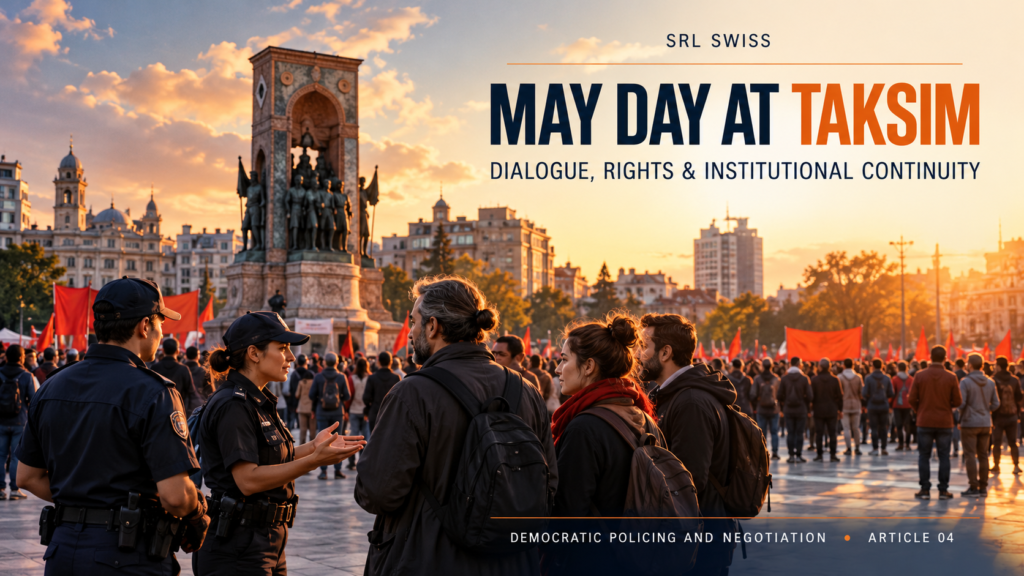
Democratic Policing and Negotiation | Article 4 of 5
SRL Research Team | 24 October 2026
May Day represents more than the commemoration of workers’ struggles. It is also a powerful reflection of the relationship between the state, society, democratic freedoms and public order. In Türkiye, Istanbul’s Taksim Square has become a particularly significant symbol of labour rights, collective memory and the exercise of freedom of peaceful assembly.
In the fourth article of its Democratic Policing and Negotiation series, SRL Swiss examines the historical development of May Day, its political significance across different societies and the evolution of policing practices in Türkiye. The analysis explores how ideological divisions, security-oriented policies and institutional decisions have shaped the authorities’ approach to public demonstrations.
Particular attention is given to the May Day celebrations held in Taksim Square between 2010 and 2012. These events demonstrated the potential of negotiation, communication and cooperation between police authorities, trade unions and civil society organisations. Academic research involving 80 police personnel found that 61.3% of respondents considered the conciliatory approach adopted by the police to have contributed to peaceful celebrations. Although this finding reflects police perceptions rather than definitive causal evidence, it provides an important perspective on the potential benefits of dialogue-based policing.
The article also examines the subsequent institutional rupture and the difficulties of preserving rights-oriented policing practices. Decisions of the Turkish Constitutional Court concerning restrictions on May Day gatherings in 2014, 2015 and 2016 illustrate the legal significance of Taksim Square, the protection of peaceful assembly and the need to assess restrictions according to the circumstances of each case.
Drawing on historical evidence, academic research and constitutional jurisprudence, the analysis argues that democratic policing cannot depend solely on temporary administrative decisions or individual initiatives. Sustainable reform requires institutional continuity, professional accountability, meaningful dialogue and effective safeguards against unnecessary or disproportionate restrictions on fundamental rights.
The central message is clear: public security and the protection of democratic freedoms are not competing objectives. Genuine democratic policing requires both to be pursued together, with dialogue and respect for fundamental rights at the centre of public-order management.
Stay informed on human rights
Read our weekly Human Rights Monitor in English. Subscribe to receive it by email.
Published in Turkish, English, German, French and Italian.