Myanmar: Civilian Protection and Human Rights — October 2026
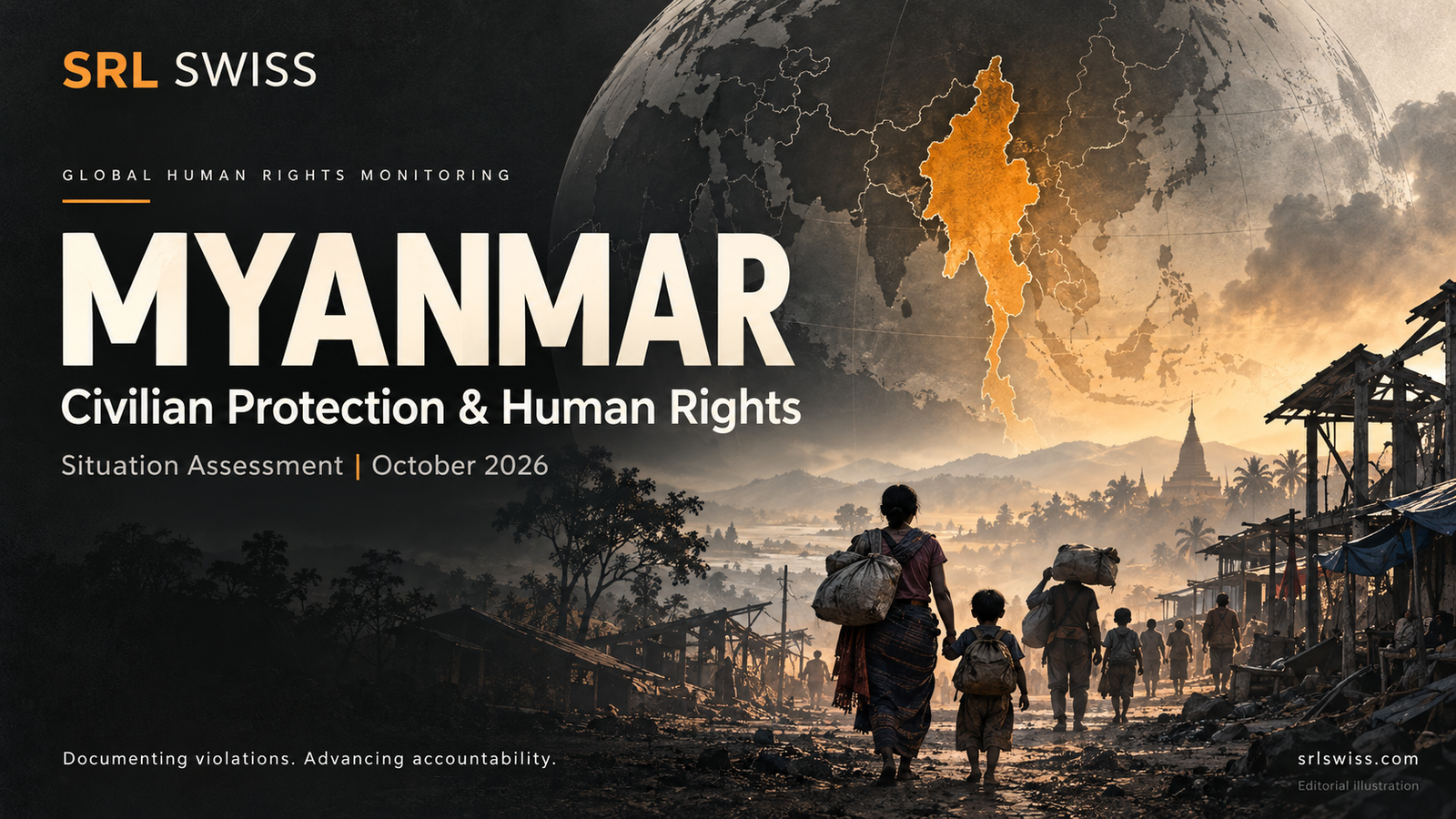
SRL Swiss presents its Myanmar situation assessment, examining the impact of armed conflict and repression on civilians and the protection needs of people forced to leave their homes. Prepared as part of the Association’s global human rights monitoring work, the report brings together United Nations documentation, independent human rights investigations, academic research and verified media reporting. It reviews selected findings published between July and October 2026 and assesses their significance under international human rights law and international humanitarian law.
The assessment places recent developments within Myanmar’s political and historical context, including the persecution of the Rohingya, the military takeover of February 2021, the expansion of armed conflict and the military-controlled electoral process of 2025–2026. It considers the transition to a new presidency in April 2026 alongside continuing reports of violence against civilians. The central concern is whether political and institutional changes have produced meaningful improvements in people’s safety, rights and access to protection.
Particular attention is given to the airstrike on a market area in Kyauktaw, Rakhine State, on 28 September 2026, which Reuters attributed to the Myanmar military. Media reporting placed the death toll at approximately 50, while Myanmar Witness’s subsequent visual investigation identified evidence consistent with at least 33 deaths. The report explains how these findings were obtained and preserves the distinction between reported casualty figures and the minimum supported by visual evidence. It examines the incident through the rules governing civilian protection, military objectives, proportionality and precautions in attack, identifying questions that require independent investigation.
Beyond this incident, the report examines arbitrary detention, torture, sexual violence, restrictions affecting ethnic and religious minorities, and the cumulative consequences of displacement. Findings from different regions are presented within their geographical and reporting limits. Particular attention is paid to the Rohingya and to the responsibilities of armed actors, including the Arakan Army in areas under its effective control. The assessment also explores how insecurity, checkpoints and administrative restrictions obstruct humanitarian assistance and place additional burdens on local relief networks.
A further focus is Malaysia’s return of 1,476 Myanmar nationals on 29 September 2026. According to Malaysia’s national human rights commission, SUHAKAM, the group included 27 children. UNHCR stated that it had been unable to meet the individuals concerned and assess whether their decisions to return were free and informed. The report considers the implications for non-refoulement, individual protection assessments and children’s rights. It stresses that a claim of voluntary return does not, by itself, establish safety at the destination, and that independent information about the returnees’ subsequent circumstances remains limited.
The legal analysis addresses the obligations of conflict parties, safeguards against torture and arbitrary detention, humanitarian access and protection against unlawful displacement. It also distinguishes the roles of the Independent Investigative Mechanism for Myanmar, the International Criminal Court and the International Court of Justice. Selected scholarship adds context on citizenship and exclusion, armed-group governance, local humanitarian action and the conditions necessary for meaningful decisions about return.
Drawing on publicly available evidence, the assessment sets out recommendations for Myanmar’s conflict parties, Malaysian authorities, international institutions and donors. Priorities include protecting civilians, facilitating impartial humanitarian assistance, ensuring UNHCR access and effective safeguards before removal, supporting independent investigations, and providing predictable assistance to local organisations.
Through this report, SRL Swiss seeks to contribute to informed international scrutiny and practical efforts to protect people affected by Myanmar’s crisis.